Setup Series #2
[05/03/26]
Setup Series #1 was aimed at identifying crucial price inflection points using technical analysis alone. If that was the science, this is the art. The market we are currently in this week is ‘fast’. High volatility and incredibly headline-sensitive prices make it difficult to trade. You have to be quick to cut anything not working [T] or give anything longer-term [S] more room, whilst vol-adjusting your sizing lower. Fading Middle-Eastern war (or the prospect of) in its infancy has in the past been a profitable strategy. The market attempted this on Monday and has come unstuck; price action since has been incredibly messy, with correlations not always ‘traditional’, given that risk-reduction (sometimes referred to as a VaR shock) and the reversion to flat of portfolios can lead to some divergent cross-asset moves that do not backtest well. This cocktail of fast price, correlation breakdown and unique fundamental read-through of the unknown energy market disruption tenure is leading me to trade - or at least monitor - the market in a way that I often find useful and will share the live example:
Simplistic thesis: “I expected the market to buy JPY as a safe-haven. I know Japan is a net energy importer; also a global manufacturing hub, ergo the higher input costs are worsening the Takaichi-policy-driven JPY weakness that has been evident. Nevertheless, I had expected the current US/Iran conflict to shift market driver decisively from idiosyncratic policy RV > global risk aversion flows”.
My core fundamental belief is that a much weaker JPY as a result of this conflict and the crude/LNG impacts will mean it is EVEN harder for the Japanese MOF/BOJ to put the genie back in the bottle if they end up intervening at 160-165. The runaway weak JPY train is leaving the station and may leave quickly if this risk aversion phase has not seen it appreciate. My belief is that fair value in USDJPY is closer to 140-145 by year-end and I was hoping a broad move lower in the USD, followed by a normalisation BOJ monetary policy (April hike) would get this move underway. I am not fighting the JPY move meaningfully at the moment, as it is not trading as I had thought it would and I do not want to get caught on the wrong side as said train leaves. I have a couple of options, but am looking for a signal to engage in cash.
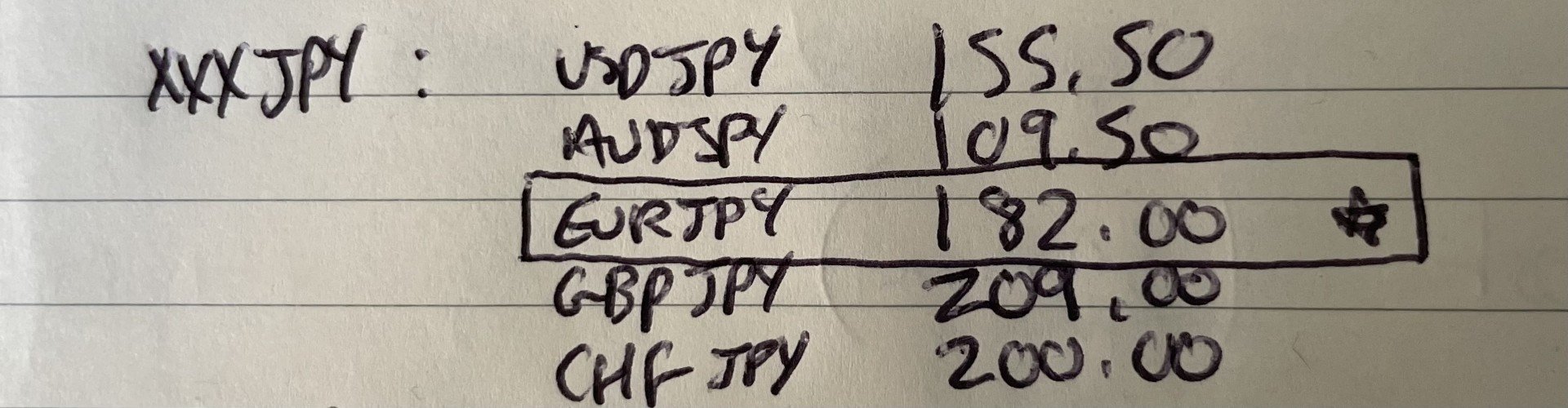
The method: basket monitoring. Rather than monitoring or trading USDJPY, I scribble down the XXXJPY lows that look relevant pre-post conflict outbreak. I have highlighted the EURJPY lows around 182 for two reasons. A) this level is relevant in the micro-term both last week and this week. B) this is in a way an RV cross to monitor in the sense that both the Eurozone and Japan are heavily dependent on energy imports and their currencies have been hurt through this outbreak. These five crosses should therefore vary in terms of unique risk sensitive characteristics and the net position the market has on in each in a VaR-reduction phase. The aim is to reduce noise, trade a JPY view without dilution and enter at an opportune moment, by diversifying the expression and increasing expected value via selective entry.
The levels can be used individually, whilst still harnessing diversification:
(1) Selling a basket of 20% size in each CCY cross and adding to the exposure only if/when the pair crosses the support.
(2) Selling technical breaks if/when any of the below cross their support, with trailing stops.
(3) Buying short-term put options on the break of respective supports, limiting downside.
However, I think the real power in this method, and how I will use it here, is for signal generation. I referred to this technique in my ‘Preparation’ post with the G10FX monitoring grid. Using a traffic light system here can help provide the signal for a larger position or higher conviction in the more liquid and level-critical USDJPY - also the likely vehicle of any intervention.
Red = 1x cross below s/t support
Amber = 2x cross through s/t support
Green = 3x cross through s/t support including EURJPY below 182
On green, you may have missed the first X% of a multi-% move in USDJPY, but in my view the expected value of the trade is then high enough to spend the money on the premium and to be more comfortable that the ‘noise’ has been silenced to distil the JPY-specific signal.