
A sporting analogy
[12/02/26]
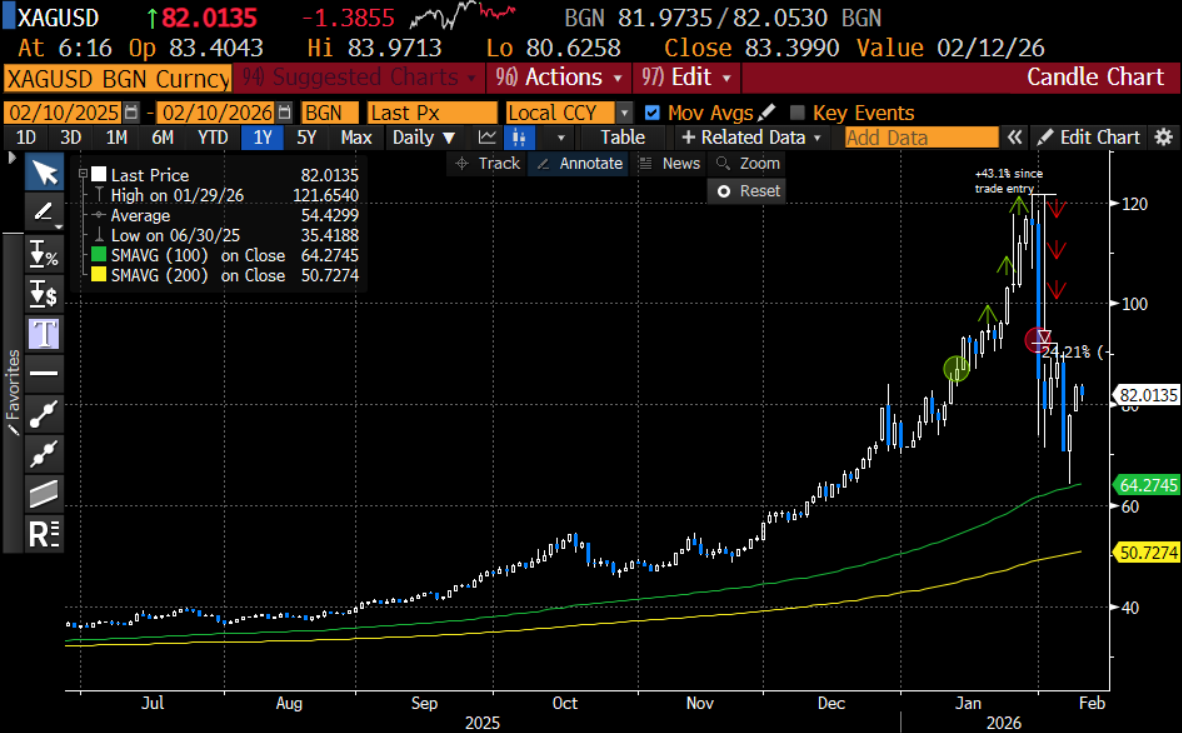
A recent combination of partial profit-taking and user-error with a new brokerage platform left me with a short vol position in an instrument that had rallied 400% during the past nine months. As of Jan13, I was short 90 calls in XAGUSD (thankfully, not in fate-defining size), with spot at an ATH of 85 upon inception (green circle) and two weeks of exposure pre-expiry to manage (Jan28: red circle). During that time, as a result of minimum-unit constraint and broker spread, it was not possible to immediately flatten the position and take the loss - instead I would have to hedge a short gamma exposure throughout the coming fortnight - in essence, I would have to buy XAG incrementally as it rallied, only to sell it back out again if/when XAG fell (represented by the directional arrows).
For anyone less familiar, the cash-flow looked like this:
Jan13: Erroneous XAGUSD 90 call sale. Premium X received from buyer.
Jan13-Jan28: Scaling into long XAGUSD position during a move higher in XAGUSD, given that upon exercise (XAG>90), I would be left short XAGUSD at 90, so needed to buy the underlying back.
3pm GMT Jan28: If XAGUSD is above 90, I sell XAGUSD to the buyer of the call at 90, having ideally already covered said exposure in the market. If XAGUSD is below 90, the option expires worthless. Premium X is kept in either scenario.
Of course, when you sell an OTM call option, the best case scenario is that the price never trades higher; upon expiry you keep premium X and no hedging is required. Doing nothing throughout the life of the derivative risks ruin (imagine if XAG was to rally another 400% pre-expiry) and is not an option. The issue with ‘delta hedging’ i.e. the activity defined by the arrows below, is that the losses and transaction costs associated with the repeat buying/selling of the underlying during unprecedented intraday volatility can quickly balloon; becoming far greater than the premium initially received. The process is enormously energy-intensive.
This, by definition, was therefore the worst case! Not only did the price rally; the volatility was face-ripping and the direction was anything but singular. XAG rose 43% in the first 12/14 days, then fell 25% into expiry on the 14th and final day. This was one of those ultra high energy expenditure trading periods during which the culmination of sleepless nights was a small loss, yet a feeling of enormous satisfaction that I had not hesitated to pull the trigger during any of the hedging and had actively traded and covered the risk throughout.
This was not my first time managing a short volatility position, nor my first time trading an instrument realising 100% volatility or trading a liquidity vacuum. It was, however, my first time doing this outside of a traditional financial institution, without high-tech risk warehouse tools or cross-time-zone colleagues, and got me thinking about how and why this felt so different; ergo how I could shape this into some form of advice or experience-forwarding.
I reflected upon how much easier managing a short volatility position was at a bank. If I was to compare it to speculating on a football game; when you’re trading at a bank, you’re on the pitch in the starting 11. You have occasional access to the ball. You’re the beneficiary of sensory overload and heightened communication. You know what/where/when is happening on the pitch and can even focus on the ball and use your ears to distinguish the areas of the pitch (trading floor) action is occurring on. You perhaps even have a VR goggle-equivalent in the form of AI-assisting tools to help you play and place bets upon the game. You have direct earpiece connection to players of other sports in adjacent stadiums and those on your team playing in other countries, and can converse with other major football speculators and game-strategists in real time; not to mention world-class timely commentary of all things football and beyond - even psychological coaching. Why does this make it easier to play and speculate upon the game/manage an intraday FX position (which a short volatility position invariably is)? Zero delay, world-class technological assistance and direct communication and coverage from team members in all time-zones. Essentially, first-person visceral playing.
So, if a bank trader is the player on the pitch, what is the Hedge Fund PM? Somebody sitting inside the stadium, with very good seating and communicative access to the players, high-stakes speculating upon the intra-game and league outcomes. The same googles, earpiece and research-backed edge; coupled with the vantage point and direct feedback advantage - particularly relevant for intra-game calls.
Finally - the experience I describe above - the retail trader or independent money manager. These are people outside the stadium, watching the game on a big screen whilst speculating on the game. The score is always in view on the screen and most information is public, however unless the phase of play is within single-shot on the screen, there can be difficulty following all aspects of the game at once. Action must be sought-out and is not presented to you. Commentary must be purchased. Technology is now sufficiently great that the risk warehouse (systems) substitute, pricing, trading commissions and delay-minimization have all served to make this as immersive an experience as possible, but you’re certainly not benefitting from visceral game-play or stadium access.
This is not a begrudged realisation; rather a view on edge-retention. Taking bets upon the number of throw-ins, corners or possession stats in said game is without-edge when you’re outside the stadium. Laying those odds, even less-so. In fact, I would argue that outside of penalties and free-kicks, during which binary events you’re able to distinguish an edge through research, modeling and deep-thinking, you’re better-off avoiding betting on intra-game nuance.
Outside of the stadium, you can adjust your trading to compensate for latency and the lack of visceral participation. Obsessively following teams and betting on player performance, scores, league outcomes and occasionally identifying the asymmetry into a penalty shoot-out is edge-retention. I would argue that with a healthy network of football fanatics and academic research, the disadvantage during greater time horizon speculation is minimal. The learning for me: bet only where you know your edge isn’t depleted, whilst using resources wisely. Day trade only when you’re certain you have an edge or when that trade forms part of a longer-term strategy. Entering short volatility positions will not form any part of my strategy. Unless attempting to pre-emptively enter a spot position at a desired level (see B.T.A.D), hence not planning to delta hedge, I will be net vol buying only.